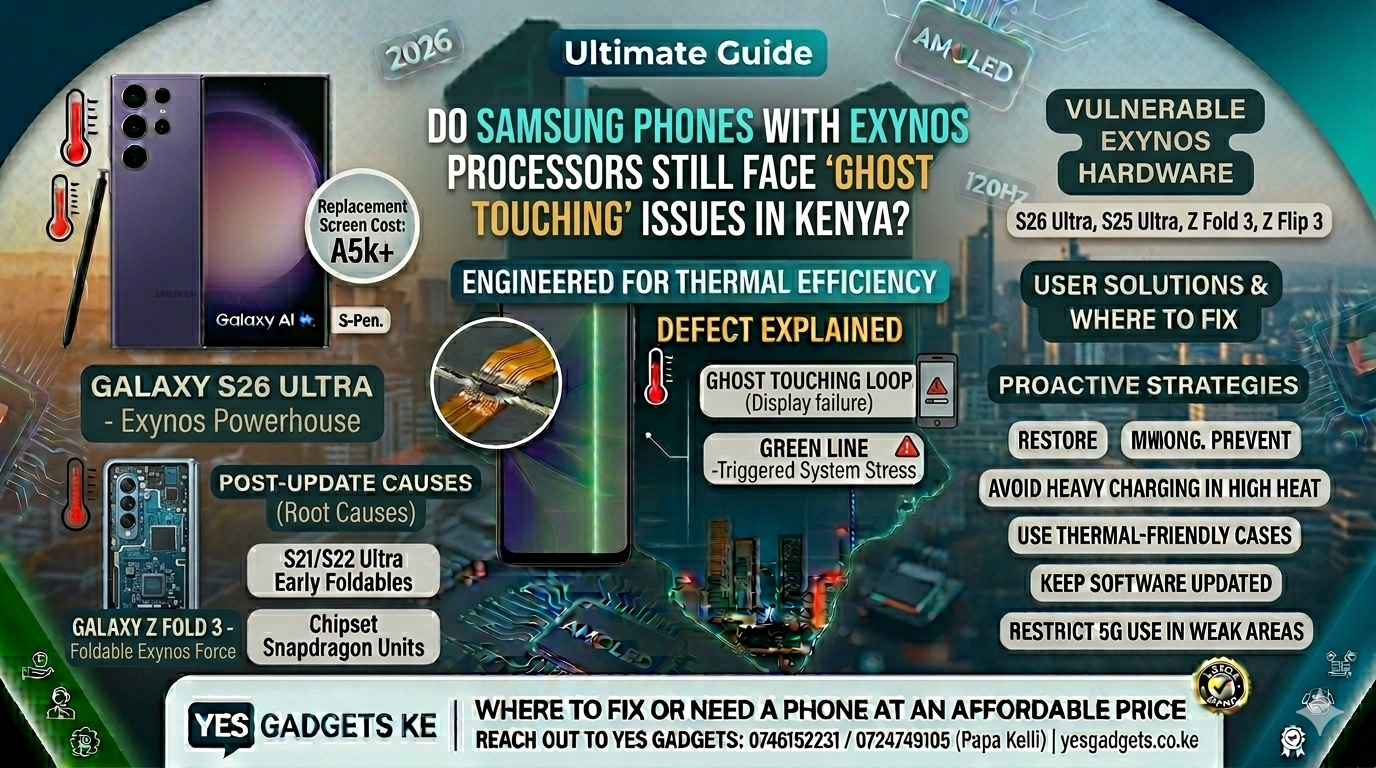
Do Samsung Phones with Exynos Processors Still Face “Ghost Touching” Issues in Kenya?
Samsung has solidified its position as the premier smartphone brand in Kenya, capturing a diverse market from Nairobi’s tech-savvy youth to corporate professionals in Upper Hill. The Korean giant dominates every segment, offering stunning displays, groundbreaking cameras, and seamless ecosystem integration. However, beneath the surface of this technological dominance lies a subtle, frustrating anxiety that plagues many Kenyan Samsung users: the dreaded “Ghost Touching” phenomenon.
For an unsuspecting user, ghost touching—when the screen registers touches that the user did not make—is not just a minor glitch; it is an immersion-breaking hardware defect that can render a premium device practically unusable. In Kenya, a market historically allocated Samsung devices powered by in-house Exynos chipsets rather than the Qualcomm Snapdragon processors sold elsewhere, a persistent rumor persists: are Exynos models inherently more prone to this irritating display failure?
This comprehensive guide dives deep into this phenomenon, separating myth from engineering reality. We will explore the technical intersection of the Exynos architecture, display mechanics, and power delivery, explaining why this problem occurs, determining if it persists in the latest Exynos models, and crucially, analyzing how Kenya’s specific environment might amplify the risk.
The Core of the Problem: Demystifying “Ghost Touching”
Before we can answer if the problem persists in the latest Exynos models, we must understand what the problem actually is. Ghost touching (or erratic touch response) is not a software glitch, a temporary error, or something that can be fixed with a simple restart. It is a fundamental hardware failure where the touchscreen’s digitizer inaccurately interprets signals, resulting in erroneous touch inputs. When it happens, it’s rarely a coincidence.
1. The Engineering Failure: FPC Bonding and Adhesives
An AMOLED display is not a single layer of glass. It is a complex sandwich of multiple layers: the actual AMOLED pixel matrix, a digitizer (touch layer), a polarized layer, and a protective front glass. These layers are connected to the phone’s main motherboard via an exceptionally delicate Flexible Printed Circuit (FPC)—essentially a flat ribbon cable.
The FPC is bonded to the display layers using a process called Anisotropic Conductive Film (ACF) bonding. Ghost touching occurs when a microscopic portion of this FPC bonding fails, or when the adhesive layers begin to degrade, allowing for slight, uncommanded fluctuations in the conductive path, specifically in the digitizer. When the connection is unstable, the digitizer misinterprets background electrical signals or slight physical deformations as intentional user input, creating the ghost touches.
2. The Relationship Between Heat and Stress
Heat is the enemy of all electronic components, but it is catastrophic for specialized adhesives and conductive bonding wires. Smartphones are designed to be compact, leaving very little room for heat to dissipate. The processor and battery generate the most heat. When the device is pushed (heavy gaming, fast charging, large-system updates, or extensive 5G usage), internal temperatures can spike.
If the internal heat is not managed effectively, it radiates outward toward the display assembly. This heat causes a tiny amount of thermal expansion in the display materials and the FPC bonding. Over hundreds or thousands of heat cycles, this continuous expansion and contraction stress the microscopic bonding points and degrade the adhesives, eventually leading to the ACF bond failure.
Special Offer!! Buy Samsung Galaxy S21 Ultra 128GB + 12GB Ram 5G Dual Xuk/ X-uk/ Exuk/ Ex-uk OFFER NOW at 20% Discount. Click Below to Buy
Samsung Galaxy S21 Ultra 128GB + 12GB Ram 5G Dual Xuk/ X-uk/ Exuk/ Ex-uk OFFER
Kenyan Context: Environmental and Infrastructural Amplifiers
In Kenya, this issue is exacerbated by two critical environmental factors:
-
Ambient Heat: In regions like Mombasa, Kisumu, or northern areas, ambient temperatures regularly exceed 30°C. A device that is already generating peak internal heat cannot dissipate that heat efficiently into warm, humid air. This keeps the internal components at elevated temperatures for longer periods, accelerating the thermal stress during an update or gaming session.
-
Network Stability (Inconsistent Coverage): Kenya’s 5G network infrastructure, while growing, is inconsistent outside of major urban cores. In “cell edge” situations or rural areas, the phone must broadcast at maximum power to maintain the 5G connection. Constant network searching stresses the modem and battery, generating peak heat that pre-stresses the motherboard and display long before a user even initiates a heavy task.
The Exynos/Snapdragon Divide: The Thermal Efficiency Gap
This is perhaps the single most significant factor in the Kenyan market. Kenya is a global region that typically receives Samsung’s flagship devices powered by their in-house Exynos chipsets, rather than the Qualcomm Snapdragon processors sold in the US. This distinction is paramount when discussing network stability, thermal management, and long-term display health.
1. Historical Struggle with Efficiency
Historically, the Exynos integrated modems and CPU clusters have lagged behind their Qualcomm counterparts in energy efficiency. While newer generations have closed this gap significantly, older models were notorious for their power-hungry nature. An inefficient processor generates more heat for the same task. This means Exynos variants of certain flagship series run consistently hotter than their Snapdragon equivalents, subjecting the display FPC bonding and digitizer to much higher levels of thermal stress over the device’s lifespan.
2. Solder Fatigue on BGA Chipsets
As discussed in previous guides concerning motherboard failure, modern processors (including Exynos) use a Ball Grid Array (BGA) architecture, where microscopic balls of solder connect the chip to the motherboard. These tiny solder connections are exceptionally vulnerable to stress. The extreme thermal cycles associated with large-system updates or intense 5G usage place unsustainable stress on these microscopic BGA bonding points. When solder fatigue sets in on the CPU or modem BGA, it can sometimes cause intermittent electrical signaling anomalies that the digitizer misinterprets as touch inputs, resulting in ghost touching.
Vulnerable Devices: Which Excellent Exynos Cameras Often Suffer in Kenya?
The issues are not uniform across the entire Samsung portfolio. Problems tend to cluster around specific model generations that prioritized cutting-edge processing or mechanical camera tech, particularly in the Exynos variants popular in Kenya.
1. The Periscope Telephoto Struggle (Z Fold 3/Z Flip 3)
Early foldable devices faced extreme engineering challenges in terms of thermal dissipation and physical space, placing immense stress on the compact mainboard.
Focus Model: Galaxy Z Fold 3 (Exynos Options)
The Z Fold 3, while a landmark design, was perhaps the first time Samsung attempted to integrate truly robust Periscope-style camera system into a tightly packed foldable chassis. Tightly packed internals meant that heat generated by the power-hungry modem and CPU had nowhere to go, placing immense thermal stress on the compact Z Fold 3’s main camera system. In warm, equatorial Kenyan climates, this resulted in rapid overheating during heavy video recording, which pre-stresses the display assembly FPC bonding long before ghost touching issues begin to manifest.
2. Early integrated Flagships (The S20 through S22 Series)
Based on widespread user reports and technical analysis, specific older flagship series—particularly the Exynos variants popular in Kenya—are the primary victims of ghost touching.
Focus Model: Galaxy S21 Ultra (Exynos 2100)
The Exynos 2100 chipset was power-hungry, particularly in Kenya’s variable 5G coverage areas. Users consistently reported significant framerate drops (lag) after just 15–20 minutes of competitive play, as the phone thermally throttled to keep the modem from failing. The resulting thermal cycles placed unsustainable stress on the delicate FPC connections and the motherboard BGA connections. This generation is perhaps the most notorious sufferers of both the “Green Line” defect and catastrophic motherboard failure post-update, both rooted in the same thermal stress loop.
Focus Model: Galaxy S22 Ultra (Exynos 2200)
While the S22 series improved modem efficiency, the Exynos 2200 was still prone to thermal management challenges, particularly under the sustained loads common in modern mobile gaming or large-system updates. The Lack of robust vapor chambers common in newer flagships means the device rapidly reaches thermal limits, pre-stressing the motherboard and display FPC bonding.
Do Samsung Phones with Exynos Processors Still Face “Ghost Touching” Issues?
The critical question remains: are the current Exynos models safe?
1. The Good News: Engineering Improvements
The current state-of-the-art in 2026 presents a very different landscape. Samsung is acutely aware of these defects and has implemented engineering changes in newer generations specifically to address thermal management. The combined effect of improved cooling and efficient chipsets significantly reduces the likelihood of the motherboard or display assembly reaching the critical thermal thresholds that cause ghost touching.
-
Advanced Vapor Chambers: Starting with the S24 series, Samsung aggressively increased the size and efficacy of the vapor chamber cooling systems. This allows the processor’s heat to be spread over a much larger surface area, significantly reducing hot spots near the delicate display connection points.
-
Chipset Improvements: Newer chipsets (both newer Exynos iterations and newer Snapdragon variants) have shown a marked improvement in energy efficiency. Less energy wasted as heat means a cooler-running device and less long-term stress on the display FPC and motherboard BGA.
-
Digitizer Robustness: Engineering advancements in 2026 have also improved the robustness of the digitizers and the conductive bonding materials used in AMOLED displays, making them less susceptible to microscopic bonding failures even under moderate thermal stress.
2. The Nuanced Answer: User Solutions and Best Practices
While the hardware has improved, Kenyan users of the latest devices still need proactive strategies to manage connectivity and heat, particularly during updates or heavy usage. The nuanced answer is that while the intrinsic vulnerability is reduced in the latest models, the risk persists if the device is pushed excessively in Kenya’s unique climate.
Understanding the User Experience: Identifying the Symptoms
Early detection is key, as the defect is often progressive. Kenyan users of the latest Exynos models should watch for these warning signs of component fatigue before ghost touching becomes a critical failure:
-
Occasional Screen Flickering: Brief, inconsistent flickering when adjusting brightness or transitioning between apps, especially when the device is slightly warm.
-
Greenish Tint at Low Brightness: A faint, green discoloration across the entire screen that is visible only when the brightness is set to its lowest level.
-
Persistent Overheating: A device that becomes uncomfortably hot to the touch during routine 5G usage or while charging is a prime candidate for future display or motherboard failure.
-
Unusual Network Lags (Data Moving Stalls): If your data icon is present (e.g., 5G/4G), but no data is actually moving, it can sometimes indicate an unstable connection to the modem BGA.
Where to Fix or Need a Phone at an Affordable Price
Navigating the landscape of modern smartphone defects, particularly those linked to catastrophic motherboard failure, ghost touching, or display defects like the Green Line, requires a partner who understands the engineering behind the problem and the realities of the local Kenyan market.
We have established that ghost touching in flagship Exynos phones is a component failure rooted in excessive heat, thermal fatigue, and mechanical stress. Therefore, you need solutions that address these fundamental factors. Whether you are a current owner struggling with an erratic A33, or a potential buyer in Nairobi looking for a reliable device that won’t fail in the heat, reach out to YES Gadgets KE at yesgadgets.co.ke.
Why Choose YES Gadgets KE?
In direct relation to the topics discussed above, YES Gadgets KE provides solutions that address the primary pain points of the Kenyan smartphone market:
-
Expert, Accountable Motherboard Servicing and Component Servicing: We highlighted that ghost touching and motherboard failure are component issues linked to thermal fatigue and stress. At YES Gadgets KE, we understand that a proper fix requires more than just a component swap; it requires expert diagnosis and component-level display servicing. We are one of the few places in Kenya with technicians trained to assess the integrity of delicate motherboard connections and camera assemblies, cutting through the inflated markups often found in large, authorized repair centers.
-
Expert Knowledge of the Kenyan Market: Our staff in Ongata Rongai are intimately familiar with the real-world performance of these Phones in Kenya. They can provide genuine advice, steering you away from problematic older models and recommending newer Samsung devices known for excellent thermal performance on local 5G networks, preventing expensive purchasing mistakes.
-
Affordable and Certified Pre-Owned Samsung Devices: If your current device is a victim of irrecoverable motherboard failures, or if you need to upgrade to a device with proven local reliability, YES Gadgets KE offers a wide range of affordable, certified pre-owned Samsung phones. We rigorously test our pre-owned stock to ensure signal stability and thermal performance on Kenyan networks before they are sold, giving you peace of mind that your new purchase will actually connect.
-
Authenticity and Accountability: In a market often flooded with refurbished units that fail on arrival, YES Gadgets KE prioritizes genuine, high-quality electronics. When you purchase or repair a device with us, you get a clear breakdown of the service, genuine parts, and an accountable guarantee, which is crucial when dealing with complex connectivity problems.
Don’t let the technical complexities of modern smartphone design limit your digital life in Kenya. Whether your current Samsung is overheating or you are in the market for a reliable, affordable device, YES Gadgets KE provides the localized expertise and accessible solutions you have been looking for.
Visit yesgadgets.co.ke today or visit their shop in Nairobi CBD, HH Towers Shop 505, to get professional advice that makes sense in the Kenyan context.