Why Do Top-Rated Phones Today Often Develop “Dead Pixels” on Their AMOLED Screens in Kenya?
Top-Rated Phones like Samsung has cemented its position as the premier smartphone brand in Kenya, captivating a diverse market from Nairobi’s tech-savvy youth to corporate professionals in Upper Hill. The Korean giant dominates every segment, offering stunning AMOLED displays, groundbreaking cameras, and seamless ecosystem integration. These “top-rated” phones, like the Galaxy S-series flagships and the innovative Fold/Flip phones, are the epitome of mobile luxury.
However, beneath the surface of this technological dominance lies a subtle, frustrating anxiety that plagues many Kenyan Samsung users: the dreaded “Dead Pixels” phenomenon.
For an unsuspecting user, a dead pixel—a tiny, permanent black speck on the display—is not just a minor visual anomaly; it is an immersion-breaking hardware defect that can make a premium device feel flawed. When you’ve invested significantly in a phone specifically for its magnificent display, seeing a persistent black dot is heartbreaking. The central question for consumers in Kenya is: why are these exceptionally advanced, top-rated AMOLED screens seemingly so vulnerable to this frustrating pixel failure?
This comprehensive guide dives deep into this phenomenon, separating myth from engineering reality. We will explore the technical intersection of AMOLED display architecture, manufacturing complexity, and, crucially, analyze how Kenya’s specific environmental and Infrastructural landscape amplifies the risk.
The Core of the Problem: Demystifying “Dead Pixels”
Before we can understand why the problem occurs, we must first define what it is. In an AMOLED display, “pixels” are the microscopic, individually powered diodes that illuminate to create an image.
1. What is a “Dead Pixel”?
A truly “Dead Pixel” is an individually addressable sub-pixel (the red, green, or blue components of a pixel) that has completely lost its ability to illuminate. It receives power, but the diode itself is functionally dead. When viewed, it appears as a tiny, perfect black speck, regardless of what the screen is attempting to display.
Note on “Stuck Pixels”: These are different. A stuck pixel is a sub-pixel that is stuck “on” (permanently illuminated red, green, or blue). They can sometimes be “unstuck” using software techniques. Dead pixels are black and cannot be recovered via software.
2. The Relationship Between AMCLED and Mortality
To understand mortality, we must understand the fundamental difference between AMOLED and traditional LCD (Liquid Crystal Display) technology.
-
LCD: Uses a central backlight that shines through a layer of liquid crystals to create colors. When a component fails, you might get backlight bleed, but individual pixel control is separated.
-
AMOLED (Active-Matrix Organic Light-Emitting Diode): Each pixel is its own light source. The “O” stands for “Organic,” meaning the diodes use organic emissive compounds. These organic materials, while allowing for magnificent contrast and deep blacks, are inherently biodegradable and susceptible to chemical and physical degradation over time. AMCLED pixels have a natural “lifespan” or “burn-in” curve, meaning their maximum brightness and color accuracy diminish over thousands of hours of use. A “Dead Pixel” is essentially an AMCLED pixel that has met an premature end on this decay curve.
Special Offer!! Buy Samsung Galaxy S25 Ultra 512GB + 12GB Ram – East Africa Warranty NOW at 20% Discount. Click Below to Buy
Samsung Galaxy S25 Ultra 512GB + 12GB Ram – East Africa Warranty
The Root Causes: Why AMCLED Pixels Die Prematurely
Pixel death on top-rated AMOLED screens, including the latest models from Samsung, typically stems from a catastrophic hardware failure, rarely from software glitches. The failure is rooted in two primary engineering challenges: manufacturing complexity and component stress.
1. Manufacturing Complexity: Microscopic Imperfections
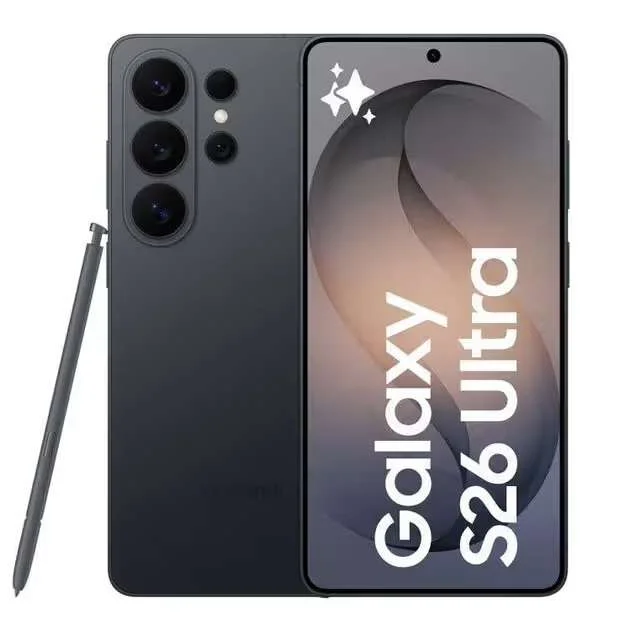
Modern AMOLED displays are among the most complex consumer electronic components ever mass-produced. A flagship phone (like the hypothetical Galaxy S26 Ultra in 2026) has millions of individual pixels. Manufacturing these dense pixel arrays at a sub-millimeter scale is an extremely high-precision process.
A tiny dust particle, a microscopic structural flaw, or a localized electrical signaling anomaly during the manufacturing process can result in a pixel that is weak from day one. These weak pixels are much more susceptible to failing under normal operating stress.
2. Solder Fatigue on the BGA Chipset (Motherboard Link)
This is a critical failure mechanism that connects pixel failure directly to the motherboard. Modern smartphone processors, modems, and power delivery ICs use a Ball Grid Array (BGA) architecture. BGA chips are connected to the motherboard via microscopic balls of solder.
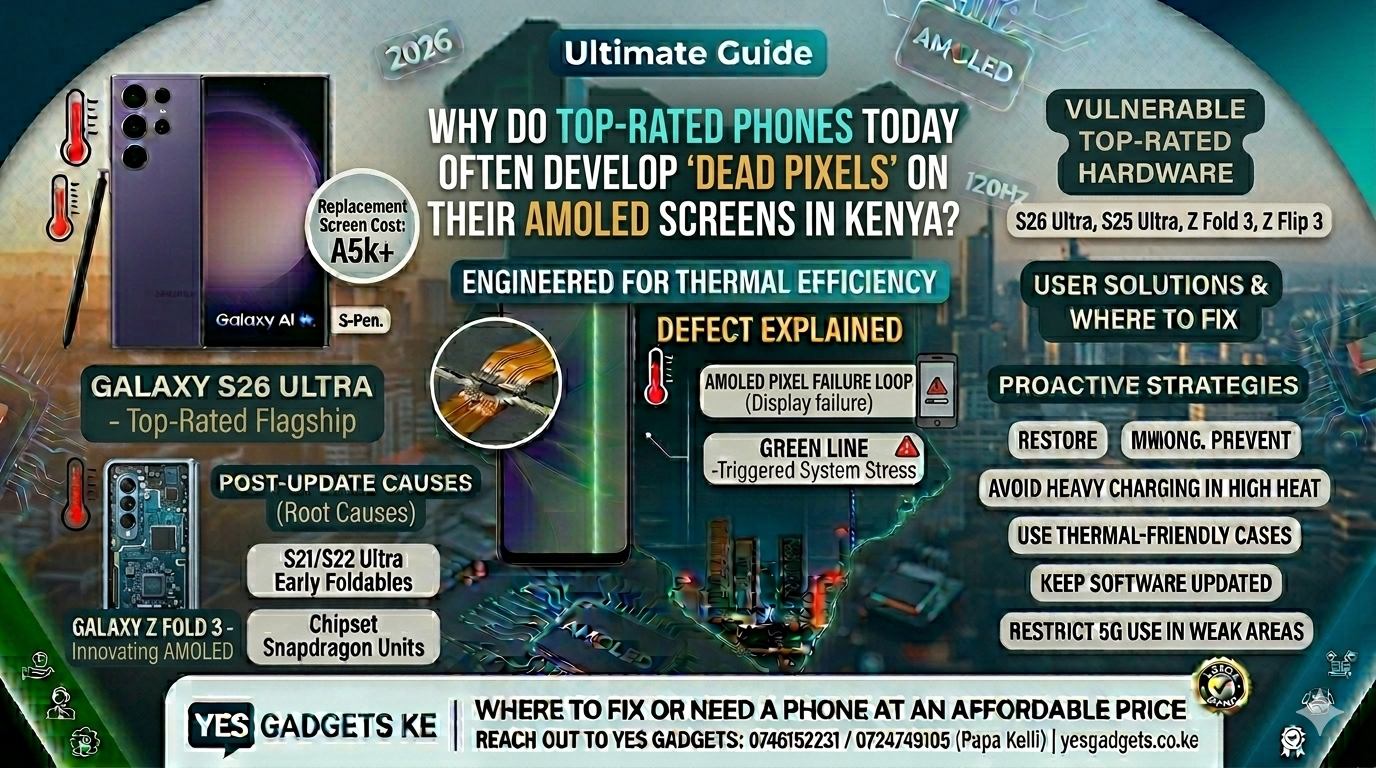
As discussed in our previous detailed analyses of post-update motherboard failure, BGA chipsets are incredibly vulnerable to thermal and mechanical stress. The extreme thermal cycles associated with large system updates, heavy gaming, or constant 5G usage pre-stress these delicate solder points. Solder fatigue sets in. When a microscopic solder ball connecting the GPU or power IC to the motherboard begins to fracture or fail, it can disrupt the critical electrical signaling paths required to address or power individual display columns. This disruption can manifest as a permanent black line (the Green Line effect) or, less catastrophically but still irritatingly, as permanent dead pixels within that affected display column.
Kenyan Context: Environmental Amplification
In Kenya, this thermal stress loop is amplified by two key factors:
-
Ambient Heat: In regions like Mombasa, Kisumu, and the northern arid areas, ambient temperatures regularly exceed 30°C. A phone, already working hard to update or game, cannot efficiently dissipate its maximum internal heat into the warm, humid Kenyan air. The internal components, including the display assembly and BGA chipsets, stay at elevated temperatures for longer, accelerating the thermal fatigue process that causes pixel failure.
-
Power Volatility (Infrastructural Stress): Sudden power fluctuations or surges during charging can place extreme electrical stress on the phone’s power management ICs. While modern phones have robust internal protection, repeated exposure to unstable voltage can slightly stress the power delivery lines on the motherboard, weakening the electrical signaling to the delicate AMCLED pixel grid, making it more susceptible to pixel failure.
How to Manage Dead Pixels on Your Current Samsung
If you own a current Samsung phone, all hope is not lost. While true dead pixels cannot be “fixed” via software, you can take proactive steps to minimize the risk:
-
Keep the Phone Cool: This is the single most important rule. Never charge your phone in direct sunlight or outdoors in warm weather. If the phone gets hot while gaming or during a large update, stop using it and allow it to cool immediately. Consider using thermal-friendly cases.
-
Avoid Sustained Peak Brightness: Heat is amplified at maximum brightness. While top-rated screens are designed to hit extreme brightness, avoid using this setting unnecessarily, particularly in warm environments. Consider setting Adaptive Brightness.
-
Regular Software Updates: It sounds counterintuitive, but Samsung often includes patches that optimize display voltage control and motherboard thermal thresholds. Ensuring your phone has the latest firmware can reduce the initial thermal stress events that fatigue the components.
-
Handle with Care: Physical shock (drops) is a primary cause of immediate pixel death, as the impact can physically fracture the delicate AMOLED structure or FPC bonding. Use high-quality protective gear.
Where to Fix or Need a Phone at an Affordable Price
Navigating the landscape of modern smartphone defects, particularly those linked to catastrophic motherboard failure, ghost touching, or complex display defects like Dead Pixels or the Green Line, requires a partner who understands the engineering behind the problem and the realities of the local Kenyan market.
We have established that Dead Pixels in top-rated AMOLED phones are often a component failure rooted in excessive heat, thermal fatigue, manufacturing complexity, and stress on delicate BGA and FPC connections. Therefore, you need solutions that address these fundamental factors. Whether you are a current owner struggling with a flickering A57, or a potential buyer in Nairobi looking for a reliable, affordable device that won’t fail in the heat, reach out to YES Gadgets KE at yesgadgets.co.ke.
Why Choose YES Gadgets KE?
In direct relation to the topics discussed above, YES Gadgets KE provides solutions that address the primary pain points of the Kenyan smartphone market:
-
Expert, Accountable Screen Repairs and Component Servicing: We highlighted that “Dead Pixels” are catastrophic component failures. A proper fix requires more than just a simple screen swap; it requires expert diagnosis and component-level display servicing, including thermal paste replacement and motherboard BGA diagnostics. We are one of the few places in Kenya with technicians trained to assess the integrity of delicate motherboard connections and AMOLED assemblies, cutting through the inflated markups often found in large, authorized repair centers.
-
Expert Knowledge of the Kenyan Market: Our staff in Ongata Rongai are intimately familiar with the real-world performance of these devices in Kenya. They can provide genuine advice, steering you away from problematic older models and recommending newer Samsung devices known for excellent thermal performance on local 5G networks, preventing expensive purchasing mistakes.
-
Affordable and Certified Pre-Owned Samsung Devices: If your current phone is a victim of irrecoverable motherboard failures, or if you need to upgrade to a device with proven local reliability, YES Gadgets KE offers a wide range of affordable, certified pre-owned Samsung phones. We rigorously test our pre-owned stock to ensure signal stability and thermal performance on Kenyan networks before they are sold, giving you peace of mind that your new purchase will actually connect.
-
Authenticity and Accountability: In a market often flooded with refurbished units that fail on arrival, YES Gadgets KE prioritizes genuine, high-quality electronics. When you purchase or repair a phone with us, you get a clear breakdown of the service, genuine parts, and an accountable guarantee, which is crucial when dealing with complex connectivity problems.
Don’t let the technical complexities of modern smartphone design limit your digital life in Kenya. Whether your current Samsung is overheating or you are in the market for a reliable, affordable phone, YES Gadgets KE provides the localized expertise and accessible solutions you have been looking for.
Visit yesgadgets.co.ke today or visit their service center in Nairobi CBD, HH Towers Shop 505, to get professional advice that makes sense in the Kenyan context.